
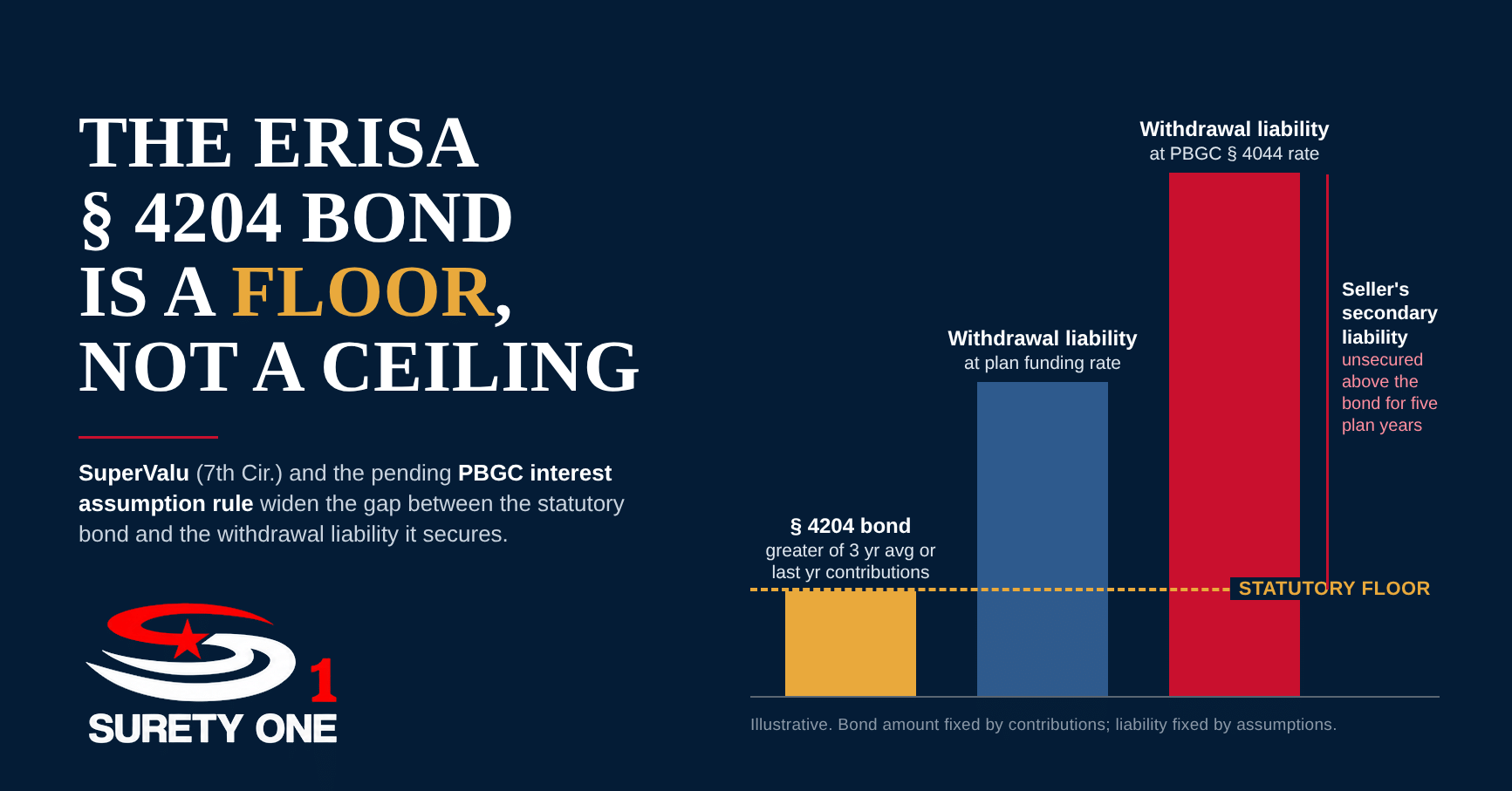
Two developments, one judicial and one regulatory, have altered the economics of selling a business that contributes to a multiemployer pension plan, and neither has received the attention it deserves from the transactional bar. The Seventh Circuit’s decision in SuperValu Inc. v. UFCW Unions and Employers Midwest Pension Fund (2025) confirms that the sale of assets exemption protects a seller from the sale and from nothing else. The Pension Benefit Guaranty Corporation’s withdrawal liability interest assumption rule, proposed in October 2022 and projected on the current Unified Agenda for final publication this month, will enlarge the liability the exemption defers (Pension Benefit Guaranty Corporation, 2022; Office of Information and Regulatory Affairs, 2026). Taken together they lead to a conclusion that sureties have understood for some time and that sellers’ counsel should now adopt as a drafting premise: the ERISA 4204 bond is a statutory minimum, the exposure it secures is growing, and the parties who treat the minimum as the measure of their protection are underinsured.
The exemption and its three conditions
Under the Multiemployer Pension Plan Amendments Act of 1980, an employer that ceases to have an obligation to contribute to a multiemployer plan, or ceases covered operations, has withdrawn and is liable for its allocable share of the plan’s unfunded vested benefits (29 U.S.C. §§ 1381, 1383). A sale of the employer’s assets to a buyer who does not assume the contribution obligation is a withdrawal by the seller. Section 4204 creates the exception. A bona fide, arm’s length sale of assets to an unrelated purchaser is not a withdrawal if three conditions are met (29 U.S.C. § 1384(a)(1)). First, the purchaser must assume an obligation to contribute to the plan for substantially the same number of contribution base units for which the seller had been obligated. Second, the purchaser must post a bond or establish an escrow, for the five plan years beginning after the sale, in an amount equal to the greater of the seller’s average annual contribution for the three plan years preceding the sale or the seller’s contribution for the last of those years, payable to the plan if the purchaser withdraws during that period and fails to make a withdrawal liability payment when due. Third, the sale contract must make the seller secondarily liable for any withdrawal liability it would have had but for the exemption, if the purchaser withdraws within those five plan years and fails to pay. A seller that distributes substantially all its assets or liquidates before the five years run must itself post a bond or escrow equal to the present value of that contingent liability (29 U.S.C. § 1384(a)(3)).
The architecture is deliberate. Congress wanted asset sales to proceed without triggering withdrawal liability that would otherwise make contributing employers unsaleable, but it did not want the plan to bear the risk that a thinly capitalized buyer would assume the contribution obligation, operate for a year, and withdraw. The ERISA 4204 bond is the plan’s security against that outcome, and the seller’s secondary liability is the plan’s backstop against the bond’s inadequacy. The bond’s amount, however, is not derived from the withdrawal liability it secures. It is derived from contributions, which are a function of the collective bargaining agreement and the number of covered employees, and which bear no necessary relation to the plan’s unfunded vested benefits or the seller’s allocable share of them. In a well funded plan the bond may exceed the liability; in a poorly funded plan with a large unfunded vested benefit pool and a modest contribution rate, the bond may be a small fraction of it. The gap between the two is the subject of this essay.
SuperValu: the exemption protects the sale, not the seller
SuperValu, a national grocery chain, sold a group of stores in September 2018 in a transaction structured under section 4204, with the buyer assuming the contribution history and posting the required bond. A few months later SuperValu closed its remaining contributing stores and withdrew completely. The fund assessed $22.6mn and set the twenty year payment schedule by reference to SuperValu’s highest three year average contribution base, as section 4219(c) requires. In doing so it excluded the sold stores’ contributions for the five years before the sale, as section 4204(b)(1) directs for purposes of computing the withdrawal liability itself, but it included those contributions for the earlier years in computing the annual payment. The inclusion roughly doubled the three year average (SuperValu, 2025).
SuperValu argued in arbitration, in the district court, and in the Seventh Circuit that the sold stores’ contributions had passed to the buyer under section 4204 and could not be counted against the seller without double counting. All three rejected the argument. The statute, the court held, expressly directs the exclusion of certain contributions in computing the amount of withdrawal liability, and says nothing comparable about the payment schedule; the buyer’s succession to the seller’s contribution history governs the buyer’s own future withdrawal liability and is irrelevant to the seller’s. The court declined to read into the statute a limitation Congress had not written (SuperValu, 2025).
The holding is narrow, but its implication for the ERISA 4204 bond is not. A seller who structures a sale under section 4204 has deferred the question of withdrawal liability, not answered it. If the seller later withdraws, its own liability is computed on its own history, sold stores included for the years the statute does not exclude, and the exemption gives it nothing. If the buyer withdraws within five years and defaults, the seller is secondarily liable for the liability it would have had at the time of sale, and the bond is the only thing standing between the seller and that liability. A seller that regards the bond as the buyer’s problem, or as a formality that the plan administers, has misread the structure. The bond is the seller’s insurance against the buyer’s failure, and the seller should underwrite it as such.
The PBGC interest rule and the growing gap
The second development enlarges the liability on the other side of the gap. Section 4213 of ERISA requires that withdrawal liability be computed using actuarial assumptions that are reasonable in the aggregate and that offer the actuary’s best estimate of anticipated experience (29 U.S.C. § 1393(a)). For three decades plans and employers litigated what that language permits, and in particular whether a plan actuary may discount unfunded vested benefits at the PBGC’s section 4044 settlement rates, which are low and produce large liabilities, or must use the higher rate the plan assumes for funding purposes, which produces smaller ones. The Second, Sixth, and D.C. Circuits reached different results on different facts, and the PBGC, which has rulemaking authority under section 4213(a)(2), proposed in October 2022 to settle the matter by regulation (Pension Benefit Guaranty Corporation, 2022).
The proposed rule provides that a plan actuary may use the section 4044 rates, the plan’s funding rate, or any rate between them, including a blend, without further justification. The practical effect is to validate the use of low discount rates that many plans had been applying and that employers had been contesting. A lower discount rate produces a larger present value of vested benefits, a larger unfunded vested benefit pool, and a larger allocable share for every withdrawing employer. The rule has sat at the final rule stage for four years. The current Unified Agenda projects final publication in November 2026, and as of this writing the PBGC continues to list it among pending proposed rules (Office of Information and Regulatory Affairs, 2026; Pension Benefit Guaranty Corporation, 2026). When it issues, two things follow for section 4204 transactions.
The first is that more sales will be structured under the exemption, because the alternative, a seller’s complete withdrawal at the time of sale, will cost more. A larger withdrawal liability is a larger incentive to defer it, and buyers will be asked to assume contribution obligations in transactions where, under a higher discount rate, the seller might simply have paid the liability and sold the assets clean. The ERISA 4204 bond will therefore be posted in more transactions, by more buyers, including buyers whose capitalization would not have satisfied a seller under the old economics.
The second is that the gap between the bond and the liability it secures will widen. The bond amount is fixed by contributions, which the rule does not touch. The seller’s secondary liability is fixed by withdrawal liability, which the rule enlarges. A seller whose contingent exposure under section 4204(a)(1)(C) was $5mn under the plan’s funding rate may find it is $8mn under the settlement rate, while the bond the buyer posts remains the greater of three years’ average contributions or last year’s, which might be $600,000. The statutory minimum was never a measure of the seller’s exposure. After the rule it will be a smaller one.
The variance provisions do not change the analysis
Counsel familiar with 29 C.F.R. part 4204 will observe that the bond requirement can be varied or waived. The regulation provides that the bond and sale contract requirements do not apply where the bond amount would not exceed the lesser of $250,000 or two percent of the plan’s average total annual contributions, where the purchaser’s average net income for the three preceding fiscal years is at least 150 percent of the bond amount, or where the purchaser’s net tangible assets equal or exceed the seller’s allocable unfunded vested benefits (29 C.F.R. §§ 4204.11 through 4204.13). The PBGC may also grant an individual variance on application where doing so would not significantly increase the risk of loss to the plan (29 C.F.R. §§ 4204.21, 4204.22).
Three observations about those provisions. The first is that they are tests of the purchaser’s financial condition on the date of determination, which is before the sale. They say nothing about the purchaser’s condition in the fourth plan year after the sale, when a withdrawal is most likely to occur and when the seller’s secondary liability would attach. A purchaser that satisfied the net income test at closing and has since lost its principal customer is a purchaser whose bond was waived at exactly the wrong moment. The second is that the net income and net tangible assets tests require disclosure of the purchaser’s financial statements to the plan and to the seller, which purchasers routinely decline, and that a purchaser in bankruptcy or a similar proceeding is disqualified from both (29 C.F.R. § 4204.13(c)). The third, and the one that matters most, is that the variance relieves the purchaser of the statutory bond. It does not relieve the seller of the secondary liability, which is a condition of the exemption that the regulation expressly preserves. A seller whose buyer qualifies for a variance has lost the only statutory security it had and kept the only statutory liability. The prudent seller’s response is to require the bond by contract regardless, and to size it to the exposure rather than to the statute.
Underwriting the ERISA 4204 bond above the floor
That is where the surety enters. The ERISA 4204 bond is a financial guarantee instrument: the surety promises to pay the plan if the purchaser withdraws within five plan years and fails to pay. The surety’s underwriting therefore turns on the purchaser’s capacity to continue contributing for five years and, if it withdraws, to pay its own withdrawal liability without default. The statutory amount sets the surety’s minimum exposure; nothing prevents the parties from negotiating a larger bond, and in the current environment the seller should. A bond sized to the seller’s secondary liability, or to a negotiated fraction of it that reflects the probability of the buyer’s withdrawal, converts the seller’s unsecured contingent claim against the buyer into a secured claim against a surety, and does so at a premium that is small against the exposure. The surety will want the purchaser’s financial statements, the plan’s most recent withdrawal liability estimate, the collective bargaining agreement, and the purchase agreement, and it will want to understand why the parties chose section 4204 over a clean withdrawal. A purchaser that cannot satisfy those requests is a purchaser the seller should not be relying on for five years. Our underwriters at ERISA-Bonds.com write section 4204 bonds at and above the statutory amount, and the negotiation over the amount is, in our experience, the most useful diligence a seller conducts.
The seller’s own bond under section 4204(a)(3) deserves the same attention. A seller that liquidates or distributes substantially all its assets within the five year period must post a bond or escrow equal to the present value of the withdrawal liability it avoided. Under the PBGC rule that present value will be larger, and sellers who intend to distribute sale proceeds to their owners should price the bond before they price the distribution.
The fiduciaries on the other side of the transaction
Section 4204 transactions are negotiated by employers, but they are administered by plans, and the plan’s trustees are fiduciaries under Title I with respect to every decision the exemption requires of them. The trustees must determine whether the sale qualifies, whether the bond is in the required amount and from an acceptable surety, whether a variance request meets the regulatory tests, and whether to call the bond when a purchaser’s payment is late. Each of those is a discretionary act affecting plan assets, and each is a potential claim: by the seller, if the trustees wrongly treat a qualifying sale as a withdrawal; by the plan’s participants, if the trustees accept an inadequate bond or grant an unwarranted variance and the purchaser withdraws; and by the PBGC, which has enforcement authority over Title IV compliance. The trustees’ protection against those claims is fiduciary liability coverage, and multiemployer trustees in particular, who serve under the Taft Hartley structure and are often not compensated for the role, should confirm that the fund’s policy reaches withdrawal liability determinations and section 4204 administration expressly, since some forms exclude Title IV matters or limit coverage to Title I breaches. The employer side has its own fiduciary exposure where the selling employer sponsors a single employer plan or a 401(k) alongside its multiemployer participation, and where the sale affects those plans’ participants. Our underwriters at FiduciaryLiabilityCoverage.com place coverage for Taft Hartley boards and for corporate sponsors, and the question of whether a given form covers Title IV administration is one they ask on every multiemployer placement (Poindexter, 2026b).
Conclusion
The ERISA 4204 bond was written in 1980 as a compromise: enough security to protect the plan against a buyer’s early withdrawal, not so much that it would deter the sales Congress wanted to permit. The compromise was struck in contribution terms because contributions were known and withdrawal liability was not. Forty six years later withdrawal liability is better known, larger, and about to be larger still, and the Seventh Circuit has confirmed that the exemption does nothing to reduce it for a seller who later withdraws. The statutory bond remains the floor. The exposure above it belongs to the seller, who should secure it by contract and by surety; to the purchaser, who should expect to be asked; and to the plan’s trustees, who should be insured for the judgments the exemption requires of them. A transaction that treats the floor as the ceiling has left the largest liability in the deal unsecured (Poindexter, 2026a).
C. Constantin Poindexter is the founder of Surety One, Inc., a thirty year surety and reinsurance underwriting veteran, attorney, and the author of The Contractor’s Guide to Surety Bonds. He also publishes at erisablog.com. To speak with an underwriter about an ERISA 4204 bond, an ERISA fidelity bond, or a fiduciary liability placement, call (919) 859-5294.
~ C. Constantin Poindexter, MA, JD, CPCU, AFSB, ASLI, ARe, AINS, AIS, CPLP
References
- Employee Retirement Income Security Act of 1974, as amended by the Multiemployer Pension Plan Amendments Act of 1980, 29 U.S.C. §§ 1381, 1383, 1384, 1393, 1399.
- Office of Information and Regulatory Affairs. (2026). Unified Agenda of Regulatory and Deregulatory Actions: Actuarial assumptions for determining an employer’s withdrawal liability (RIN 1212-AB54).
- Pension Benefit Guaranty Corporation. (2022, October 14). Actuarial assumptions for determining an employer’s withdrawal liability (proposed rule), 87 Fed. Reg. 62316.
- Pension Benefit Guaranty Corporation. (2026). Pending proposed rules [Web page].
- Poindexter, C. C. (2026a). ERISA fidelity bonds: A practical underwriting guide (2026 ed.) [White paper]. Surety One, Inc. https://constantinpoindexterauthor.com/publications/
- Poindexter, C. C. (2026b). Fiduciary liability insurance: A practical coverage and risk guide (2026 ed.) [White paper]. Surety One, Inc. https://constantinpoindexterauthor.com/publications/
- SuperValu Inc. v. United Food and Commercial Workers Unions and Employers Midwest Pension Fund, 155 F.4th 913 (7th Cir. 2025).
- Variances for Sale of Assets, 29 C.F.R. pt. 4204.