
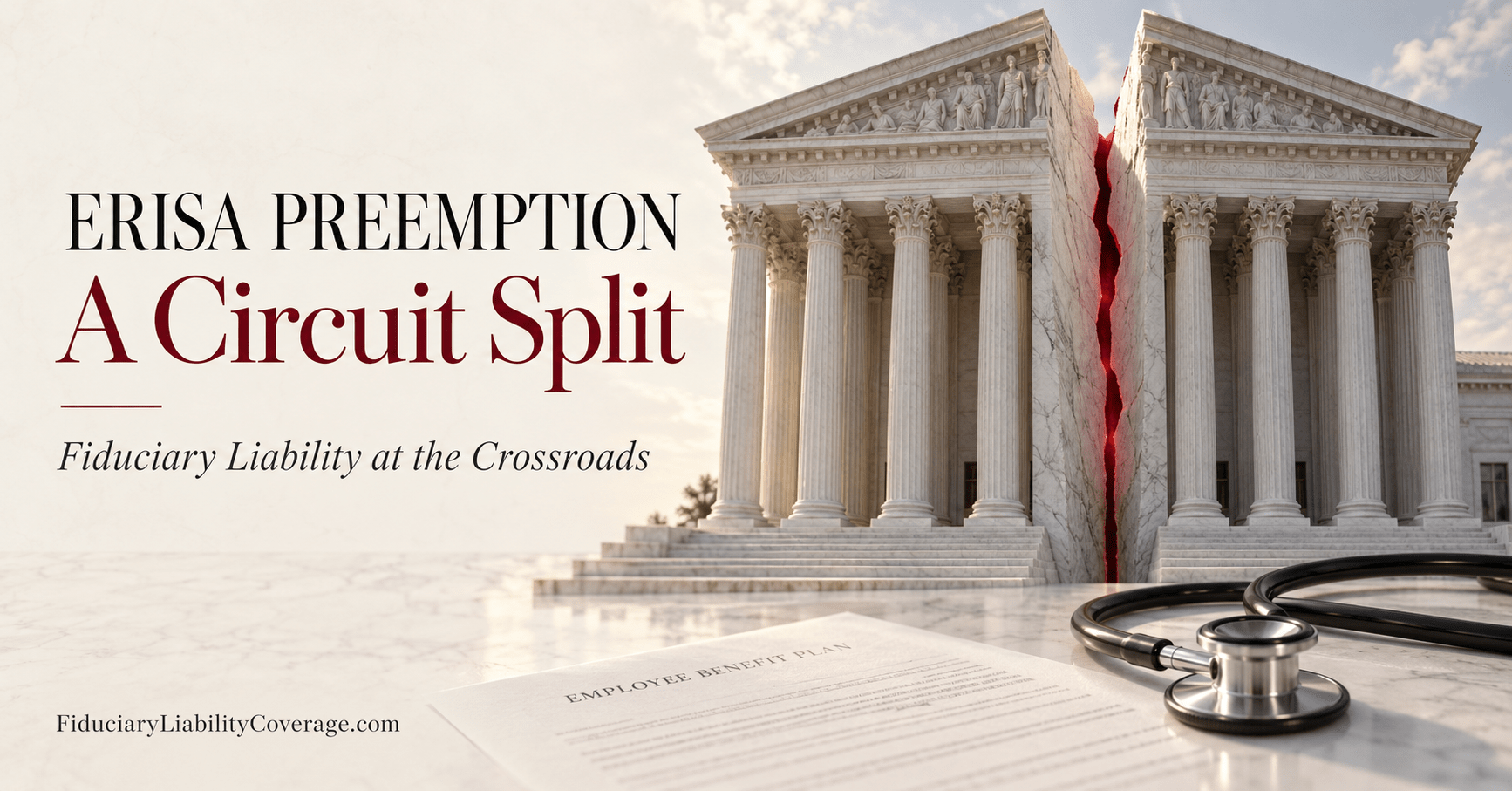
Eight Days, Two Circuits, Opposite Results: The ERISA Preemption Circuit Split Over Benefits Verification Calls.
In August 2026, two federal courts of appeals confronted the same fact pattern and reached opposite conclusions. An out-of-network medical provider telephones a plan administrator before treatment, asks how the employer’s health plan will reimburse a procedure, is told that payment will be made at the “usual, customary, and reasonable” rate, renders the care, and then receives a check calculated on the Medicare fee schedule, a small fraction of the billed charge. The provider sues the plan sponsor and the administrator in state court for negligent misrepresentation. The question is whether the Employee Retirement Income Security Act of 1974 preempts that claim. On August 11, the Ninth Circuit said no (Healthcare Ally Management of California, LLC v. WSP USA, Inc., 2026). On August 19, the Sixth Circuit said yes (Laurel Hill Management Services, Inc. v. La-Z-Boy Inc., 2026). The result is a genuine ERISA preemption circuit split on a question that arises thousands of times a day in the ordinary administration of self-funded health plans, and it carries direct consequences for how plan sponsors and their administrators should think about fiduciary liability coverage.
The statutory framework
ERISA’s express preemption clause supersedes “any and all State laws insofar as they may now or hereafter relate to any employee benefit plan” (29 U.S.C. § 1144(a)). The Supreme Court has carved out that expansive language with two categories. A state law “relates to” a plan when it makes impermissible “reference to” ERISA plans, meaning it acts immediately and exclusively upon them or their existence is essential to the law’s operation, or when it has an impermissible “connection with” a plan, meaning it governs a central matter of plan administration or interferes with nationally uniform plan administration (Gobeille v. Liberty Mutual Insurance Co., 2016; Rutledge v. Pharmaceutical Care Management Association, 2020; California Division of Labor Standards Enforcement v. Dillingham Construction, N.A., Inc., 1997). Common law causes of action are state laws for this purpose (Pilot Life Insurance Co. v. Dedeaux, 1987; 29 U.S.C. § 1144(c)(1)).
The difficulty is that a provider suing over a verification call is not a participant, beneficiary, or fiduciary. ERISA’s civil enforcement provision, 29 U.S.C. § 1132(a), gives such a provider no cause of action of its own. If the state tort claim is preempted, the provider is left without any remedy, federal or state, for an inaccurate representation on which it relied. That gap has driven most circuits toward the view that provider misrepresentation claims survive preemption. The Fifth Circuit reached that conclusion in 1990 (Memorial Hospital System v. Northbrook Life Insurance Co., 1990), and the Eleventh, Ninth, and Eighth Circuits followed (Lordmann Enterprises, Inc. v. Equicor, Inc., 1994; Meadows v. Employers Health Insurance, 1995; In Home Health, Inc. v. Prudential Insurance Co. of America, 1996). The Sixth Circuit alone went the other way, over a vigorous dissent, holding that negligent misrepresentation and promissory estoppel claims premised on an administrator’s oral assurances of coverage were “at the very heart” of ERISA’s exclusive domain (Cromwell v. Equicor-Equitable HCA Corp., 1991).
The Ninth Circuit: Healthcare Ally Management v. WSP USA
The Ninth Circuit’s decision arose from a surgery performed by La Peer Surgery Center on a participant in WSP USA’s self-funded plan, administered by Aetna. Before the procedure, La Peer called Aetna, which represented that the patient would be responsible for a portion of the charges and that the plan would pay the balance at the UCR rate. The plan instead paid the Medicare rate, roughly five percent of the bill. La Peer’s successor in interest, Healthcare Ally Management of California, sued WSP and Aetna for negligent misrepresentation, promissory estoppel, and benefits under § 1132(a)(1)(B). The district court dismissed everything: the ERISA claim for want of derivative standing and the state claims as preempted (Healthcare Ally Management, 2026).
The panel affirmed dismissal of the promissory estoppel claim under its own precedent, which had found breach of contract and promissory estoppel claims by an out-of-network provider preempted because they sought to supplant plan terms governing the relationship between ERISA entities (Bristol SL Holdings, Inc. v. Cigna Health & Life Insurance Co., 2024). But it reversed on negligent misrepresentation. Applying the “connection with” test, the court reasoned that the relationship between a provider and a plan administrator falls outside ERISA’s regulatory scope precisely because ERISA gives providers no cause of action; Congress evidently did not intend to regulate that relationship. Applying the “reference to” test, the court held that a negligent misrepresentation claim does not act immediately and exclusively upon ERISA plans and does not depend on their existence. The injury flowed from the misstatement, not from the plan’s denial of a benefit (Healthcare Ally Management, 2026). The case was remanded for the merits of the tort claim.
The Sixth Circuit: Laurel Hill Management v. La-Z-Boy
Eight days later, the Sixth Circuit decided an appeal by three surgical providers who had treated a participant in La-Z-Boy’s plan, administered by Blue Cross Blue Shield of Michigan. Blue Cross representatives had orally confirmed the patient’s deductible and out-of-pocket maximum and stated that reimbursement would be at the UCR rate. The providers billed $342,296 and were paid $1,598.40, an amount “based on Medicare” (Laurel Hill, 2026). They sued in California state court for negligent misrepresentation and promissory estoppel; the case was removed and transferred to the Eastern District of Michigan, which dismissed under Cromwell.
Judge Hermandorfer, writing for a unanimous panel, affirmed. The opinion is candid that the result is dictated by circuit precedent rather than by a fresh reading of the statute: the court was “constrained” by Cromwell, which involved “materially identical” claims, and the panel observed that this was “arguably a stronger case” for preemption because the participant in Cromwell had not even been covered by any plan when the assurances were given (Laurel Hill, 2026). The providers’ efforts to distinguish Cromwell all failed. The assignment of benefits in Cromwell had played no role in its preemption analysis. The providers had not pleaded a pure “extent of payment” claim based on a rate agreement separate from the plan; their own complaint tethered the representations to the plan’s terms, alleging that Blue Cross never disclosed plan “exclusions, limitations, or qualifications” that would reduce payment. And no intervening Supreme Court decision had undermined Cromwell’s reasoning. The court expressly limited its holding to negligent misrepresentation and promissory estoppel claims arising from an administrator’s oral assurances about coverage or reimbursement terms, leaving open whether claims on separate rate agreements would fare differently (Laurel Hill, 2026).
Judge Murphy concurred in full but wrote separately to say what the majority could not. Quoting the Third and Seventh Circuits, he described Cromwell as a “poorly reasoned” “outlier” (Laurel Hill, 2026, Murphy, J., concurring, quoting Plastic Surgery Center, P.A. v. Aetna Life Insurance Co., 2020, and Franciscan Skemp Healthcare, Inc. v. Central States Joint Board Health & Welfare Trust Fund, 2008). His analysis is worth reading in its entirety. A plan administrator contracts with landlords, employees, lawyers, and accountants, and ERISA has never been thought to immunize the administrator from state contract and tort law in those relationships. He could see no principled reason why a provider that relies on the administrator’s affirmative misstatement to render care should be treated differently, and he catalogued the weight of contrary authority, including the Ninth Circuit’s decision of the prior week. He would “interpret Cromwell as narrowly as its logic would allow” going forward (Laurel Hill, 2026, Murphy, J., concurring). A concurrence of that kind is an invitation to future litigants, to en banc review, and to the Supreme Court.
Why the ERISA preemption circuit split matters to fiduciaries
For a self-funded plan sponsor, the practical upshot is that the enforceability of a state tort claim over a verification call now depends on where the plaintiff can sue. A national employer with facilities in California and Michigan faces exposure on identical facts in one state and a preemption defense in the other. Three observations follow.
The verification call is administration. ERISA defines a fiduciary functionally, by the exercise of discretionary authority or control over plan management or administration (29 U.S.C. § 1002(21)(A)). Whether a particular representative’s statement on a particular call rises to a fiduciary act is a fact question, but the sponsor remains responsible for the prudent selection and monitoring of the administrator that makes those statements, and in Healthcare Ally Management the sponsor, WSP, was a named defendant alongside Aetna. The circuit split does not change the fiduciary’s duty; it changes who else can sue when the duty is performed badly.
The ERISA preemption circuit split will be litigated in coverage as well as in tort. Fiduciary liability policies typically define a “wrongful act” to include any negligent act, error, or omission in the “administration” of a plan, and “administration” is commonly defined to include interpreting the plan, handling records, and giving counsel or advice with respect to benefits. A representative’s statement to a provider about the rate at which the plan will reimburse sits comfortably within that language on many forms. Whether a claim brought by a third-party provider, rather than by a participant, falls within the insuring agreement, and whether a promissory estoppel count triggers a contractual liability exclusion, are questions that turn entirely on the wording of the particular policy. Sponsors who assume that “we have fiduciary coverage” should read the definitions of Claim, Wrongful Act, and Administration, and should confirm how the administrator’s own errors and omissions coverage interacts with the sponsor’s policy on allocation and priority. Our underwriters at FiduciaryLiabilityCoverage.com review those definitions on every placement, because the difference between a policy that responds to a Healthcare Ally Management claim and one that does not is not the limit; it is the language.
The fidelity bond does not help here at all. ERISA § 412 requires every person who handles plan funds or other property to be bonded against loss from fraud or dishonesty, in an amount of at least ten percent of funds handled, subject to the statutory floor and ceiling (29 U.S.C. § 1112(a); 29 C.F.R. § 2580.412-1 et seq.; U.S. Department of Labor, 2008). That bond is a mandatory instrument, and Form 5500 audits routinely flag plans that lack it or carry it in an insufficient amount, but its trigger is dishonesty. A negligent misstatement on a verification call, an imprudent plan design, or a failure to monitor a service provider is not dishonesty, and the surety will not respond. Plan sponsors who carry the § 412 bond and nothing else have satisfied the statute and left the fiduciary exposure uninsured. The bond itself can be placed in minutes at ERISA-Bonds.com. The harder and more consequential conversation is the one about what the bond does not cover.
What comes next
Two paths lead out of the ERISA preemption circuit split. The Sixth Circuit could take Cromwell up en banc; Judge Murphy’s concurrence reads as a brief in favor of doing so. Or a petition for certiorari could present the Supreme Court with a clean conflict between the Ninth Circuit’s August 11 opinion and the Sixth Circuit’s August 19 opinion on materially identical facts, decided eight days apart. The Court has shown sustained interest in ERISA questions in recent Terms, and a preemption question that leaves a class of claimants with no remedy in one circuit and a full tort remedy in the others is the kind of conflict the Court exists to resolve.
Until then, the prudent course for plan committees is documentary. Standardize the verification script across all locations. Require that any statement of reimbursement methodology be accompanied by a written disclaimer referencing plan exclusions and limitations, and that the call be logged. Confirm in writing with the administrator which party bears responsibility for representations made to providers and how that allocation is reflected in the administrative services agreement. Then read the fiduciary policy against those facts. A committee that has done those things has a defensible record whichever way the split is ultimately resolved. There are some other interesting fiduciary liability and ERISA cases this month which are of import to plan trustees, sponsors, advisors and others. Follow our blog to keep abreast of these.
~ C. Constantin Poindexter, MA, JD, CPCU, AFSB, ASLI, ARe, AINS, AIS, CPLP
References
- Bristol SL Holdings, Inc. v. Cigna Health & Life Insurance Co., 103 F.4th 597 (9th Cir. 2024).
- California Division of Labor Standards Enforcement v. Dillingham Construction, N.A., Inc., 519 U.S. 316 (1997).
- Cromwell v. Equicor-Equitable HCA Corp., 944 F.2d 1272 (6th Cir. 1991).
- Employee Retirement Income Security Act of 1974, 29 U.S.C. §§ 1002(21)(A), 1112(a), 1132(a), 1144(a), 1144(c)(1).
- Franciscan Skemp Healthcare, Inc. v. Central States Joint Board Health & Welfare Trust Fund, 538 F.3d 594 (7th Cir. 2008).
- Gobeille v. Liberty Mutual Insurance Co., 577 U.S. 312 (2016).
- Healthcare Ally Management of California, LLC v. WSP USA, Inc., No. 24-3479, __ F.4th __, 2026 WL 2319896 (9th Cir. Aug. 11, 2026).
- In Home Health, Inc. v. Prudential Insurance Co. of America, 101 F.3d 600 (8th Cir. 1996).
- Laurel Hill Management Services, Inc. v. La-Z-Boy Inc., No. 25-1727 (6th Cir. Aug. 19, 2026).
- Lordmann Enterprises, Inc. v. Equicor, Inc., 32 F.3d 1529 (11th Cir. 1994).
- Meadows v. Employers Health Insurance, 47 F.3d 1006 (9th Cir. 1995).
- Memorial Hospital System v. Northbrook Life Insurance Co., 904 F.2d 236 (5th Cir. 1990).
- Pilot Life Insurance Co. v. Dedeaux, 481 U.S. 41 (1987).
- Plastic Surgery Center, P.A. v. Aetna Life Insurance Co., 967 F.3d 218 (3d Cir. 2020).
- Rutledge v. Pharmaceutical Care Management Association, 592 U.S. 80 (2020).
- Temporary Bonding Rules, 29 C.F.R. pt. 2580.
- U.S. Department of Labor, Employee Benefits Security Administration. (2008). Field Assistance Bulletin 2008-04: Guidance regarding ERISA fidelity bonding requirements.