A Quiet Assumption on the Island, the “Hacienda Letter” is not enough. The Determination Letter Is Not a Bond: ERISA Fidelity Bonding and Puerto Rico Plan Sponsors, take heed.
An ERISA bond is required for a Puerto Rico plan exactly as it is for a plan in North Carolina, Texas or New York. Section 412 of the Employee Retirement Income Security Act of 1974 makes no distinction between a 401(k) plan administered in Raleigh and a retirement plan qualified under the Puerto Rico Internal Revenue Code and administered in San Juan, Bayamón or Mayagüez. Every fiduciary and every person who handles plan funds must be bonded. Yet among Puerto Rico employers, their accountants and many of the local professionals who serve them, a quiet assumption persists: that a plan qualified on the island lives outside the federal ERISA fidelity bond requirement.
That assumption is wrong, and it is understandable. Puerto Rico maintains its own tax code, its own qualification regime and its own mandatory review of retirement plan documents by the Departamento de Hacienda. A sponsor who has satisfied Hacienda, received a favorable determination letter and filed the required returns has every reason to believe the plan is in good standing. The difficulty is that Hacienda’s determination letter answers a tax question. The ERISA bond answers a different question entirely, one that arises under federal labor law and that no local tax review ever asks.
The practical evidence that the assumption is widespread is circumstantial but difficult to ignore. In fifteen years of writing ERISA fidelity bonds for plans across the United States, our firm has issued remarkably few for Puerto Rico sponsors. The island’s economy, its manufacturing base and its population of private employers do not explain that disproportion. A more plausible explanation is that a meaningful number of Puerto Rico plans that should carry an ERISA bond simply do not.
This essay sets out why the ERISA bond Puerto Rico sponsors are told they can do without is in fact mandatory, why the Hacienda determination letter creates a false sense of completeness, why the belief in an exemption is a fallacy, and what the national data suggest about compliance on the island.
ERISA Reaches Puerto Rico by Its Own Terms
The starting point is the statute itself. Section 4(a) of ERISA extends Title I to any employee benefit plan established or maintained by an employer engaged in commerce or in any industry or activity affecting commerce. Section 3(10) then defines “State” to include Puerto Rico, alongside the fifty states, the District of Columbia and the other territories. Congress did not leave the island’s status to inference. It wrote Puerto Rico into the definitions on which the entire coverage provision rests.
The Department of Labor confirmed that reading almost immediately after enactment. In Advisory Opinion 75-20, issued in January 1975, the Department addressed a welfare plan maintained in Puerto Rico and concluded that such plans are subject to Part 1 (Reporting and Disclosure), Part 4 (Fiduciary Responsibility) and Part 5 (Administration and Enforcement) of Title I (U.S. Department of Labor 1975). Three years later, in Advisory Opinion 78-6A, concerning the pension plan of the Puerto Rican Cement Company, the Department was even more direct. It noted that none of the statutory exceptions to coverage applies to Puerto Rican plans as a class and stated plainly that “title I of ERISA, including part 4 of that title, covers Puerto Rican plans” (U.S. Department of Labor 1978).
Part 4 is where the bonding requirement lives. Section 412 sits inside Part 4 of Title I, among the fiduciary responsibility provisions. When the Department says Part 4 covers Puerto Rican plans, it is saying, necessarily, that the ERISA bond requirement covers Puerto Rican plans. The Department has applied the same framework to other Puerto Rico arrangements, including its 1982 analysis of individual retirement account programs offered on the island (U.S. Department of Labor 1982).
The point survives the island’s separate tax regime. Practitioners who specialize in Puerto Rico plans have long emphasized that a plan intended to qualify only under the Puerto Rico Internal Revenue Code of 2011, and not under Section 401(a) of the U.S. Internal Revenue Code, escapes the U.S. qualification rules but not Title I. As Groom Law Group put it, such plans “are not subject to the qualification provisions of the US Code,” yet they “are subject to Title I of ERISA” (Groom Law Group 2016). Tax qualification and labor law coverage are separate tracks. A plan can leave the first without leaving the second.
The requirement that follows is the same one every mainland sponsor faces. Each person who handles plan funds must be bonded in an amount equal to at least 10 percent of the funds handled in the preceding year, with a minimum of $1,000 and a maximum of $500,000, or $1mn for plans holding employer securities. The bond must name the plan as insured, must be written by a surety on the Treasury Department’s Circular 570 list, and may not carry a deductible on the required amount (ERISA Advisory Council 2018). A Puerto Rico sponsor’s ERISA bond must meet every one of those terms.
The Hacienda Determination Letter Is Not a Bond
Puerto Rico imposes a step that mainland sponsors no longer face. Under the Puerto Rico Internal Revenue Code, every retirement plan intended to be qualified on the island, whether qualified only in Puerto Rico or dual qualified under both codes, must obtain a favorable determination letter from the Puerto Rico Treasury Department as to its tax-qualified status (Groom Law Group 2016). On the mainland, the Internal Revenue Service sharply curtailed its determination letter program for individually designed plans in 2017, and many sponsors never seek one. In Puerto Rico, the letter is compulsory. That compulsory review is a strength of the island’s system, and it is also the source of the misunderstanding. A sponsor who has hired counsel or a plan consultant, assembled a plan document, amended it for the Puerto Rico Code, submitted it to Hacienda and received a favorable letter has been through a demanding regulatory process. It is natural for that sponsor to conclude that the plan has been reviewed by the government and found compliant. The letter is framed, filed and cited when anyone asks whether the plan is in order.
The letter, however, speaks only to tax qualification. Hacienda examines whether the plan document satisfies the coverage, nondiscrimination, contribution and distribution rules that entitle the trust and its participants to favorable tax treatment under Puerto Rico law. Hacienda does not administer Title I of ERISA. It does not ask whether the people who handle plan money are bonded, does not request a copy of a fidelity bond, and does not condition the letter on the existence of an ERISA bond. Nothing in the determination process addresses Section 412 at all.
The result is a compliance gap that the sponsor cannot see. The tax side of the plan has been reviewed in detail by a government agency, and the labor side has been reviewed by no one. A sponsor holding a favorable determination letter can be fully qualified under the Puerto Rico Code and, at the same time, in violation of federal law because no ERISA bond covers the plan. The more rigorous the Hacienda process feels, the more confident the sponsor becomes that nothing remains to be done, and the less likely anyone is to ask the bonding question.
The Form 5500 reinforces the confusion rather than curing it. Plans qualified solely in Puerto Rico are Title I plans and file the annual return like any other, and the return asks directly whether the plan was covered by a fidelity bond (Form 5500-SF line 10b; Schedules H and I, line 4e). For a sponsor who believes the plan is a local arrangement, that question is easy to answer “no” without alarm, or to leave to a preparer who shares the same assumption.
The Exemption Fallacy
The belief that a Puerto Rico sponsor is exempt from bonding is a fallacy in the strict sense: a conclusion that does not follow from its premises. The premises are true. Puerto Rico has its own tax code. The plan is qualified under that code. Hacienda has approved it. The conclusion, that the plan therefore needs no ERISA bond, does not follow, because none of those premises touches the federal statute that imposes the requirement. ERISA does recognize real exemptions, and it is worth stating them precisely, because each one turns on what the plan is and never on where it is located:
- Governmental plans. Plans established by a government or its agencies are excluded from Title I by Section 4(b)(1). The retirement systems of the Commonwealth, its municipalities and its public corporations fall here.
Church plans. Plans of churches and certain related organizations are excluded by Section 4(b)(2) unless they elect coverage. - Plans without employees. A plan that covers only the business owner, or the owner and spouse, is not a Title I plan under the Department’s regulations.
- Unfunded welfare plans. A welfare plan that pays benefits solely from the employer’s general assets, including many insured arrangements whose premiums are paid from those assets, does not require a bond under the bonding regulations.
- Regulated institutions. Certain banks, insurance companies and registered broker-dealers that handle plan assets are exempt from the bonding requirement for their own handling, though the plan’s internal officials are not.
None of these exemptions mention Puerto Rico, and none is available to a private employer’s funded retirement plan merely because the plan is qualified on the island. As the Department of Labor observed in 1978, none of the statutory exceptions apply to Puerto Rican plans as a class (U.S. Department of Labor 1978). An ERISA bond exemption must be found in the character of the plan. It cannot be found in its address.
The national evidence shows how often sponsors who believe themselves exempt are mistaken. In its 2015 National Bonding Project, the Employee Benefits Security Administration sent compliance letters to a stratified sample of 1,200 plans that had reported no bond on their 2013 Form 5500. Of the plans that responded by claiming an exemption, “a little less than half actually were exempt” (ERISA Advisory Council 2018). More than half of the sponsors who were confident enough to assert an exemption to the federal regulator were wrong. There is no reason to expect better accuracy from Puerto Rico sponsors, whose belief in an exemption rests on a theory, the separate tax code, that has no legal footing at all.
What the National Numbers Suggest About the Island
No published study has measured ERISA bond compliance among Puerto Rico plans specifically. The national record, however, is substantial, and it points in one direction. Noncompliance with Section 412 is common. It is concentrated among small plans, and its principal cause is confusion about what the law requires.
The federal findings are consistent across agencies and years:
| Study | Population | Finding |
|---|---|---|
| DOL informal Form 5500 survey | Small employee benefit plans | Roughly one third had no required fidelity bond |
| EBSA 2015 plan year review | Small pension and small welfare plans | Only about two thirds reported bond coverage; nearly all large plans did |
| EBSA Philadelphia Regional Office, 2014 | Plans reporting no bond for 2012 | 61% of closed investigations found at least one bonding violation |
| EBSA National Bonding Project, 2015 | 1,200 plans reporting no bond for 2013 | 43% purchased a bond after receiving a compliance letter |
| EBSA 2015 plan year review | 140 plans reporting a fraud or dishonesty loss | 58 reported a loss larger than the bond amount |
| IRS compliance project | Qualified plans with outdated business codes | Inadequate bonding in over 20% of plans reviewed |
Sources: ERISA Advisory Council (2018); Internal Revenue Service (n.d.).
The ERISA Advisory Council attributed this pattern to “a lack of awareness of the fidelity bond requirements and confusion over which insurance coverage is required and which insurance coverage is voluntary,” and found the problem concentrated among small plan sponsors and “the commercial service providers who serve the small plan market” (ERISA Advisory Council 2018). The Council also noted that ERISA bonds are “widely available, easily obtainable, and relatively inexpensive,” so cost cannot explain the gap.
Every factor the Council identified is present in Puerto Rico, and several are amplified. The island’s private economy is built on small and mid-sized employers. Its government is a very large employer, accounting for roughly 198,400 of about 964,900 nonfarm payroll jobs in May 2025, or about one job in five (Puerto Rico Department of Labor and Human Resources 2025). Those public sector jobs fall outside ERISA, so the private plans that remain are, on average, smaller plans served by local professionals. Workplace plan coverage is also thinner than on the mainland: in an AARP survey, 44 percent of Puerto Rico workers reported no access to a retirement plan through their employer (AARP 2017), compared with roughly 31 percent of private industry workers nationally (Bureau of Labor Statistics data reported in 401(k) Specialist 2022).
To those national drivers, Puerto Rico adds one of its own: the Hacienda determination letter, which gives sponsors documentary reassurance that their plan has been reviewed and found compliant. A small sponsor who is already uncertain about the difference between a fidelity bond and other insurance, and who holds a government letter approving the plan, is exactly the sponsor least likely to purchase an ERISA bond.
If roughly a third of small plans nationwide lack a required bond, there is little reason to believe the figure is lower in Puerto Rico, and good reason to suspect it is higher. Our own experience, a book of business in which island sponsors are strikingly scarce, is consistent with that suspicion. The Form 5500 data that would settle the question are public, and the bonding answers Puerto Rico sponsors have given on their returns deserve close study.
The Cost of Being Wrong
The absence of an ERISA bond rarely produces a visible consequence until something goes wrong, which is precisely why the exemption fallacy survives. There is no annual certificate to renew with a regulator and no local agency that asks for proof of coverage. The exposure is real nonetheless, and it falls on people rather than on the plan.
Section 412 makes it unlawful for any person to receive, handle, disburse or otherwise exercise custody or control of plan funds without being bonded, and equally unlawful for a plan official to permit such a person to do so. A fiduciary who allows an unbonded bookkeeper, officer or administrator to handle plan money is not merely out of technical compliance. That fiduciary has failed to discharge a duty imposed by Part 4 of Title I, and under Section 409 a fiduciary who breaches Part 4 duties is personally liable to make good the resulting losses to the plan.
The scenario is not hypothetical. When an employee diverts contributions, forges a distribution or embezzles from the trust, a plan with a compliant ERISA bond has a direct claim against the surety for the loss up to the bond amount. A plan without a bond has no such recovery. Participants, the Department of Labor or a successor fiduciary will then look to the individuals who allowed plan funds to be handled without the protection the statute requires. In a closely held Puerto Rico company, those individuals are usually the owners and senior officers themselves.
The Form 5500 adds a second layer of risk. The annual return asks whether the plan was covered by a fidelity bond and in what amount, and an answer reporting no bond, or a bond below the required amount, is information the Department of Labor uses to select plans for review. A knowingly false answer on a document required by Title I is a separate matter under federal criminal law (18 U.S.C. § 1027). A sponsor who believes the plan is exempt may answer honestly and invite scrutiny, or answer carelessly and create a worse problem.
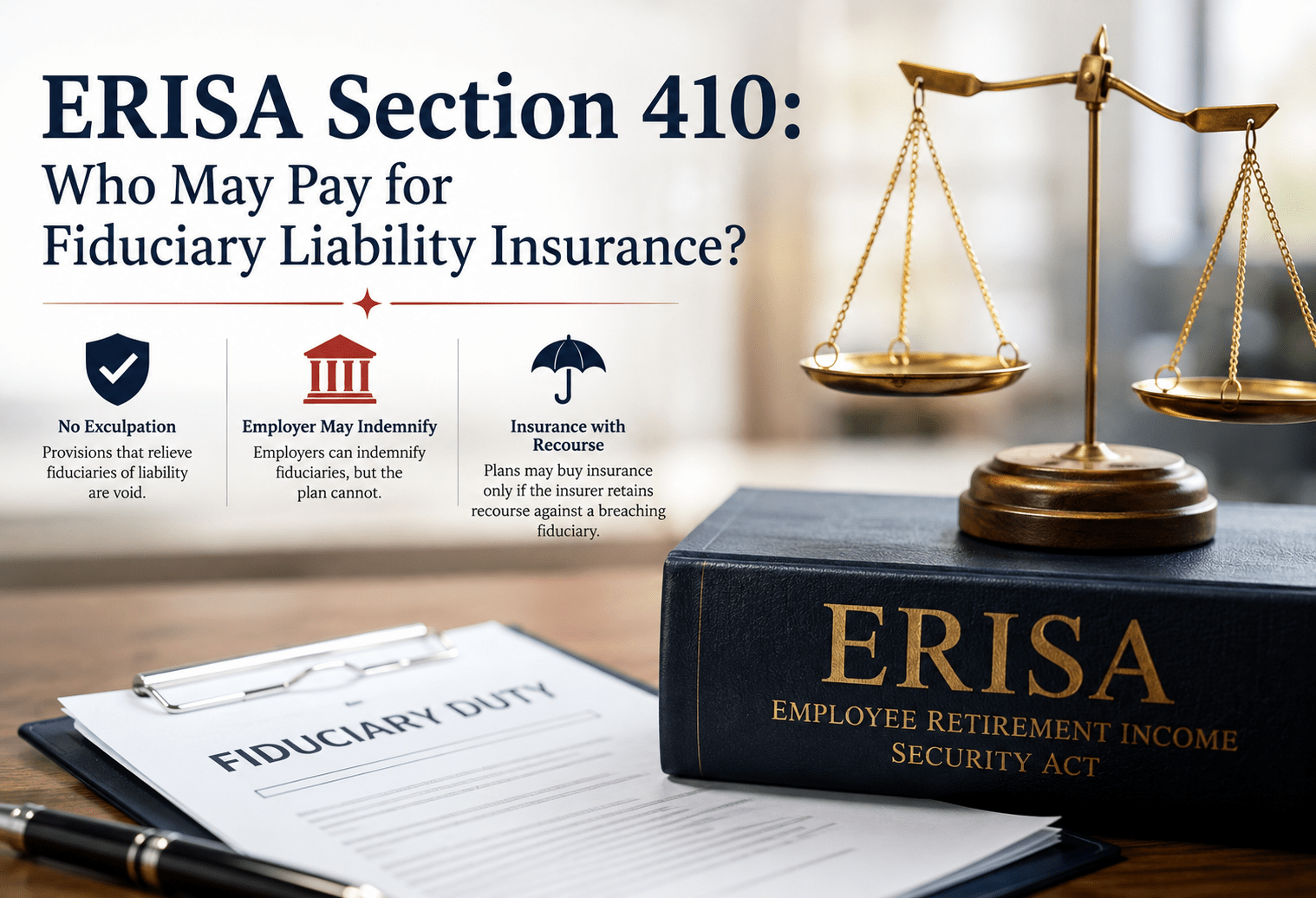
It is also important to understand what the ERISA bond does not do. The bond protects the plan against theft and dishonesty by those who handle its assets. It does not protect fiduciaries against claims that they breached their duties through imprudent investment choices, excessive fees or administrative error. That protection comes from fiduciary liability insurance, a separate product that the Advisory Council found sponsors frequently confuse with the bond (ERISA Advisory Council 2018). A Puerto Rico sponsor who discovers that its plan needs an ERISA bond should ask, in the same conversation, whether its fiduciaries are personally protected.
Closing the Gap
The remedy is simple, inexpensive and fast, which makes the persistence of the gap all the more striking. A Puerto Rico sponsor, or the professional who advises one, should take four steps:
1. Confirm Title I status. Unless the plan is governmental, a church plan, a plan with no employees or an unfunded welfare arrangement, assume it is a Title I plan and that an ERISA bond is required, regardless of whether it is qualified under the Puerto Rico Code, the U.S. Code or both.
2. Review the last Form 5500. Check how the plan answered the fidelity bond question and what amount it reported. A “no” or a blank is a problem to correct now, not at the next filing.
3. Size the bond correctly. Bond each person who handles plan funds for at least 10 percent of the funds handled in the prior year, subject to the $1,000 minimum and the $500,000 maximum, or $1mn where the plan holds employer securities. Plans holding nonqualifying assets may require more.
4. Separate the bond from other coverage. Confirm that the plan is the named insured, that no deductible applies to the required amount, and that the coverage is a true ERISA bond rather than a commercial crime policy that merely resembles one.
Accountants, third-party administrators and insurance producers on the island have a particular role to play. The Advisory Council found that confusion among the service providers who serve small plans is a principal driver of noncompliance nationally (ERISA Advisory Council 2018). In Puerto Rico, a relatively small number of local firms prepare many small plan filings. If those firms ask the bonding question as routinely as they ask about Hacienda qualification, the ERISA bond Puerto Rico sponsors have been missing will become a standard part of plan administration.
The Hacienda determination letter is a valuable document. It proves that a plan satisfies the Puerto Rico Code. It does not prove that the plan satisfies ERISA, and it never claimed to. A sponsor who treats the letter as a certificate of complete compliance has confused a tax approval with a labor law obligation, and the ERISA bond is where that confusion becomes costly.
Surety One, Inc. issues ERISA fidelity bonds for plans in all fifty states and Puerto Rico, typically the same day the application is received, through ERISA-Bonds.com. Fiduciaries who want protection for their own personal exposure, which the ERISA bond does not provide, can obtain fiduciary liability insurance through FiduciaryLiabilityCoverage.com. For Puerto Rico plan sponsors, securing an ERISA bond is the first step in putting the federal side of the plan in the same good order as the tax side.
~C. Constantin Poindexter Salcedo, MA, JD, CPCU, AFSB, ASLI, ARe, AINS, AIS, CPLP, is the founder of Surety One, Inc., a surety and fidelity underwriter with offices in Raleigh, San Juan and Santo Domingo, and the author of The Contractor’s Guide to Surety Bonds. For all things “ERISA” follow Surety One’s ERISA and fiduciary liability blog.
References
- 401(k) Specialist. 2022. “7 in 10 Private Sector Workers Have Access to Employer-Provided Retirement Plans.” https://401kspecialistmag.com/7-in-10-private-sector-workers-have-access-to-employer-provided-retirement-plans/
- AARP. 2017. “Financial Security and Retirement in Puerto Rico.” AARP Research. https://www.aarp.org/pri/topics/work-finances-retirement/financial-security-retirement/financial-security-retirement-puerto-rico/
- ERISA Advisory Council. 2018. Evaluating the Department’s Regulations and Guidance on ERISA Bonding Requirements and Exploring Reform Considerations. Washington, DC: U.S. Department of Labor. https://www.dol.gov/sites/dolgov/files/ebsa/pdf_files/2018-evaluating-the-departments-regulations-and-guidance-on-erisa-bonding-requirements-and-exploring-reform-considerations.pdf
- Groom Law Group. 2016. “Puerto Rico Plans: 2016 Plan Amendments and Compulsory Determination Letter Filings.” https://www.groom.com/resources/puerto-rico-plans-2016-plan-amendments-and-compulsory-determination-letter-filings/
- Internal Revenue Service. n.d. “Employee Plans Learn, Educate, Self Correct, Enforce Project: Invalid Business Codes (Project Number 3).” https://www.irs.gov/node/7733
- Puerto Rico Department of Labor and Human Resources. 2025. “Empleo Asalariado No Agrícola.” https://www.mercadolaboral.pr.gov/lmi/pdf/Default/CES/Empleado%20Asalariado%20No%20Agricola.pdf
- U.S. Department of Labor. 1975. Advisory Opinion 75-20. https://www.dol.gov/agencies/ebsa/about-ebsa/our-activities/resource-center/advisory-opinions/1975-20
- U.S. Department of Labor. 1978. Advisory Opinion 78-6A. https://www.dol.gov/sites/dolgov/files/EBSA/about-ebsa/our-activities/resource-center/advisory-opinions/1978-06a.pdf
- U.S. Department of Labor. 1982. Advisory Opinion 82-23A. https://www.dol.gov/sites/dolgov/files/EBSA/about-ebsa/our-activities/resource-center/advisory-opinions/1982-23a.pdf