
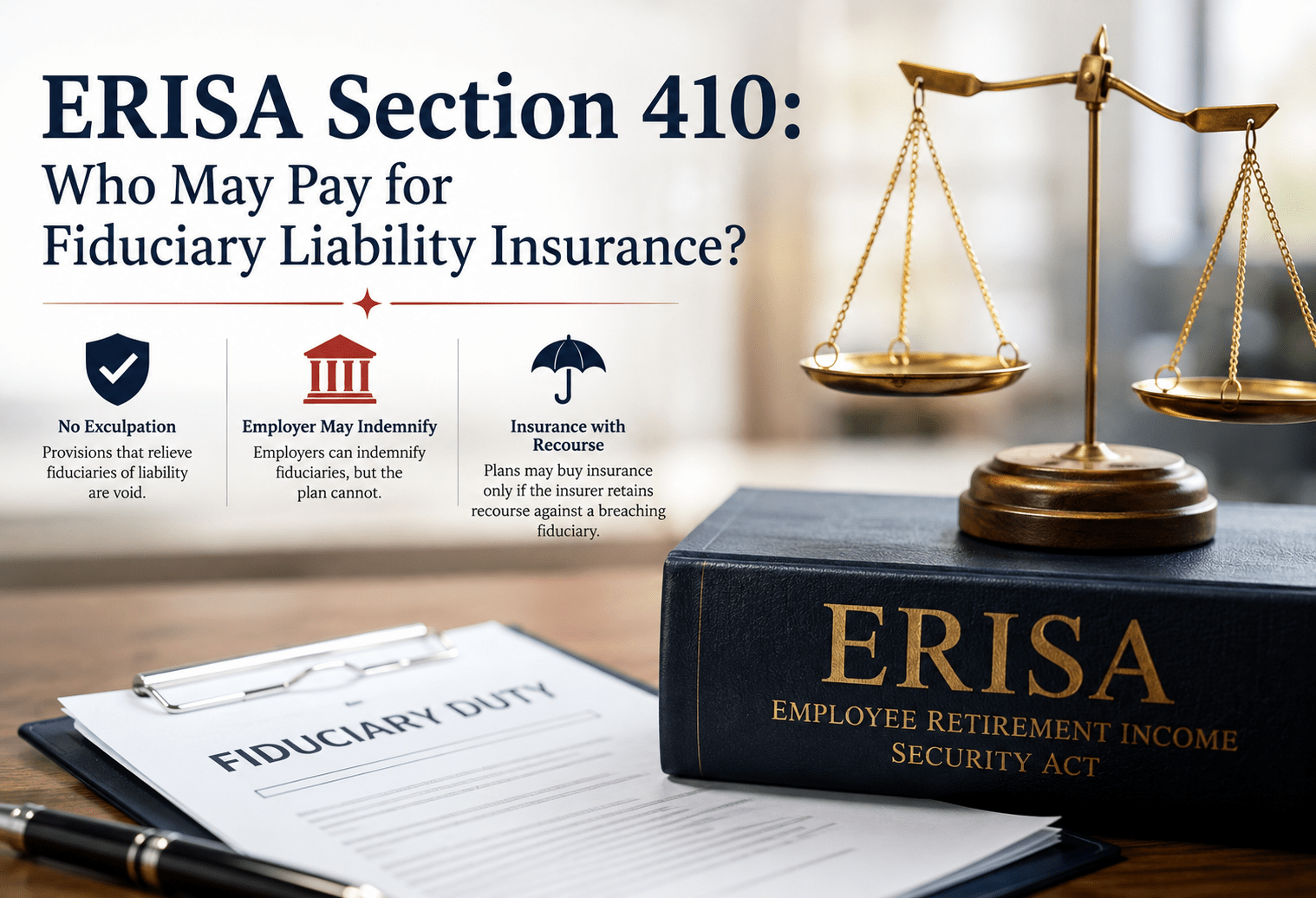
ERISA Section 410 does three things. It voids any provision that purports to relieve a fiduciary of responsibility or liability. It permits an employer to indemnify a fiduciary but forbids the plan itself from doing so. And it permits a plan to purchase fiduciary liability insurance with plan assets only if the policy gives the insurer recourse against a breaching fiduciary. The employer and the fiduciary may buy the same coverage without that condition. In practice, this single provision decides who is named on the policy, who pays the premium, whether a waiver of recourse endorsement is needed, and whether an indemnification clause in a plan document is worth the paper it is printed on.
Two neighbors in Part 4 of Title I
Section 412 of ERISA, the bonding provision, and Section 410, the exculpation and insurance provision, sit two sections apart in Part 4 of Title I.[1] Practitioners tend to treat them as unrelated. Section 412 mandates an ERISA fidelity bond that protects the plan against fraud or dishonesty by persons who handle plan funds. Section 410 says nothing about bonds at all. Yet the two provisions are mirror images. Section 412 governs the plan protecting itself from the people who run it. ERISA Section 410 governs whether, and how, the plan may protect those same people from the consequences of their own breaches. A plan sponsor who understands one provision and not the other will buy the wrong coverage, pay for it from the wrong pocket, or rely on an indemnity that a court will refuse to enforce.
This essay examines ERISA Section 410 as a coverage placement problem. It asks a practical question that the statute answers with unusual precision: who may pay for fiduciary liability insurance, and on what terms?
Subsection (a): the death of exculpation
Under the common law of trusts, a settlor could exculpate a trustee for ordinary negligence. The Restatement (Second) of Trusts permitted an exculpatory clause to relieve a trustee of liability for breach so long as the trustee did not act in bad faith, intentionally, or with reckless indifference.[2] Congress rejected that model. ERISA Section 410(a) provides that, except as provided in Sections 405(b)(1) and 405(d), “any provision in an agreement or instrument which purports to relieve a fiduciary from responsibility or liability for any responsibility, obligation, or duty under this part shall be void as against public policy.”[3]
The two exceptions are narrow. Section 405(b)(1) allows co-trustees to allocate specific responsibilities among themselves, and Section 405(d) relieves trustees of liability for the acts of a properly appointed investment manager.[4] Neither is an exculpation in the trust law sense. They are allocations of duty, not releases from it. Outside those two doors, no plan document, trust agreement, committee charter, or service agreement can shield a fiduciary from liability for a breach of the duties imposed by Sections 404, 405, and 406.
The practical consequence is stark. A fiduciary who breaches is personally liable under Section 409 to make good any losses to the plan and to restore any profits, and may be removed.[5] Nothing in the governing documents can change that result. The only questions left are whether someone else may pay, and whether an insurer may be that someone else.
Indemnification: the employer may, the plan may not
The Department of Labor addressed the first of those questions within a year of ERISA’s enactment. Interpretive Bulletin 75-4, codified at 29 C.F.R. § 2509.75-4, draws the line that still governs. Indemnification agreements that leave the fiduciary “fully responsible and liable, but merely permit another party to satisfy any liability incurred by the fiduciary in the same manner as insurance purchased under section 410(b)(3),” are not void.[6] The employer or the employee organization may therefore agree to indemnify a plan committee member, a trustee, or a service provider.
Indemnification by the plan is a different matter. The Department interprets ERISA Section 410(a) “as rendering void any arrangement for indemnification of a fiduciary of an employee benefit plan by the plan,” because such an arrangement “would have the same result as an exculpatory clause” by abrogating the plan’s right of recovery against the fiduciary who harmed it.[7] A plan cannot use its own assets to make a breaching fiduciary whole for the losses that fiduciary caused. The circularity would be absurd.
The line between employer assets and plan assets is usually easy to draw. It is not easy when the employer is owned by the plan. In Johnson v. Couturier, the Ninth Circuit affirmed an injunction barring a company that was wholly owned by its ESOP, and in liquidation, from advancing defense costs to fiduciaries under corporate indemnification agreements.[8] Because every dollar paid by the company reduced the liquidation proceeds flowing to the ESOP, the court treated the indemnity as one funded, in substance, by the plan, and held the agreements likely void under ERISA Section 410(a). The Department of Labor has since argued that Couturier establishes a general rule for ESOP-owned companies. That position was rejected in Harris v. GreatBanc Trust Co., where the district court dismissed the Department’s Section 410 claim, distinguished Couturier on its unusual facts, and applied the plan asset regulation to hold that an operating company’s assets are not plan assets merely because the ESOP owns the stock.[9] The Ninth Circuit has not revisited the question, and the Department continues to demand that trustees forgo indemnification as a condition of settlement. Readers of this blog’s ESOP valuation litigation analysis will recognize the pattern: the indemnity that an ESOP trustee negotiates at the outset may be the first thing the Department attacks when the transaction is challenged.
Subsection (b): three ways to buy fiduciary liability insurance
Indemnification depends on the indemnitor remaining solvent and willing. Insurance does not. ERISA Section 410(b) provides that nothing in the fiduciary responsibility part precludes three distinct purchasers of coverage:
The plan may purchase insurance “for its fiduciaries or for itself to cover liability or losses occurring by reason of the act or omission of a fiduciary, if such insurance permits recourse by the insurer against the fiduciary in the case of a breach of a fiduciary obligation by such fiduciary.”[10] The fiduciary may purchase insurance to cover his or her own liability “from and for his own account.”[11] The employer or employee organization may purchase insurance “to cover potential liability of one or more persons who serve in a fiduciary capacity.”[12]
Only the first door carries a condition, and the condition is recourse. When the plan pays the premium, the insurer must retain the right to recover from a fiduciary who is adjudicated to have breached. The logic is the same as the bar on plan indemnification. If plan assets bought a policy that fully absolved the breaching fiduciary, the plan would in effect be paying to release its own claim.
The Department confirmed this reading in Field Assistance Bulletin 2008-04, the same bulletin that governs ERISA fidelity bonding. Question 2 explains that fiduciary liability insurance “is neither required by nor subject to section 412,” that its purchase is governed by ERISA Section 410, and that “any such policy paid for by the plan must, however, permit recourse by the insurer against the fiduciary in the case of a fiduciary breach.” The bulletin then adds the sentence on which the entire fiduciary liability market is built: “In some cases, the fiduciary may purchase, at his or her expense, protection against the insurer’s recourse rights.”[13]
That sentence describes the waiver of recourse endorsement. Fiduciary liability policies are typically written with a recourse provision so that the plan may lawfully pay the premium. The endorsement waiving recourse is then purchased separately, for a modest additional premium, and that additional premium must be paid by the fiduciaries personally or by the sponsoring employer, never by the plan.[14] A sponsor who lets the plan pay the entire invoice, endorsement included, has walked the policy back into ERISA Section 410(a).
The advancement problem that insurance solves
Couturier was not, at bottom, a case about indemnification. It was a case about advancement of defense costs, and it illustrates the gap that no indemnity can close. A fiduciary named in a Department of Labor complaint or a participant class action must fund a defense before any court has decided whether a breach occurred. If the indemnitor is the plan, advancement is void. If the indemnitor is an ESOP-owned company, advancement may be enjoined. If the indemnitor is a thinly capitalized sponsor, advancement may simply not happen.
A fiduciary liability policy places the advancement obligation on an insurer that is neither the plan nor the employer, and that undertakes to advance defense costs subject to a right of repayment only if the conduct is later adjudicated to fall within an exclusion. Because the insurer stands outside the plan, ERISA Section 410(a) has no purchase on it. This is why the coverage matters even for sponsors whose indemnification agreements are perfectly drafted. The forfeiture misuse action analyzed in this blog’s fiduciary liability coverage case study shows what a defense looks like when there is no policy and no solvent indemnitor: the fiduciaries fund it themselves or they do not fund it at all.
The Section 412 mirror
Return now to the bond. Every feature of the ERISA fidelity bond that seems arbitrary in isolation becomes intelligible once ERISA Section 410 is placed beside it. The plan must be the named insured on the bond, because the bond exists to protect the plan.[15] The bond may carry no deductible, because a deductible would shift part of the plan’s protection back onto the plan.[16] A bond may not exclude losses the sponsor “knew or should have known” were likely, because, in the Department’s words, “the plan is the insured party, not the employer or plan sponsor.”[17] And the plan may pay the bond premium from plan assets without any recourse condition at all, because, as Question 11 of FAB 2008-04 explains, “such bonds do not benefit plan officials or relieve them from their obligations to the plan.”[18]
The contrast is the whole lesson. The bond protects the plan from its fiduciaries, so the plan may pay for it freely. Fiduciary liability insurance protects the fiduciaries from the consequences of their breaches, so the plan may pay for it only if the insurer keeps a claim against the breaching fiduciary alive. A sponsor who confuses the two and treats the bond as personal protection or the policy as a plan expense with no strings attached has misread both provisions. Underwriters at Surety One, Inc., who have issued more than 25,000 ERISA fidelity bonds through ERISA-Bonds.com since 2012, encounter this confusion almost daily. The bond application arrives from a sponsor who believes the bond will defend the committee. It will not, and it was never meant to. The Department’s current bonding guidance, discussed in this blog’s analysis of FAB 2026-01, reinforces the point.
For sponsors and their advisors, ERISA Section 410 reduces to five questions at placement.
Who is paying? If the employer pays the fiduciary liability premium, Section 410(b)(3) applies, and no recourse provision is required. If the plan pays any portion, Section 410(b)(1) applies, and the policy must permit recourse.
Is there a waiver of recourse endorsement, and who paid for it? The endorsement premium must come from the fiduciaries or the employer. Document the separate payment.
What does the indemnification clause say? Language indemnifying fiduciaries “to the fullest extent permitted by ERISA Section 410” from employer assets is enforceable. Language purporting to indemnify from plan assets is void under Interpretive Bulletin 75-4. Language that excludes only “gross negligence” or “willful misconduct,” without excluding adjudicated fiduciary breach, invites the Couturier result.
Is the sponsor owned by the plan? ESOP-owned companies should assume the Department will challenge any indemnity or advancement arrangement, and should treat fiduciary liability insurance as the primary, not supplementary, layer of protection.
Was the purchase decision itself prudent? Where the plan pays, the decision to buy coverage with plan assets is a fiduciary act subject to Section 404. The committee should minute its reasoning, the reasonableness of the premium, and the presence of the recourse provision.
Sponsors who want a policy structured around these questions, rather than around a generic management liability form, can begin at FiduciaryLiabilityCoverage.com, where Surety One places fiduciary liability insurance for single employer, multiemployer, and ESOP sponsored plans with attention to who is named, who pays, and whether recourse has been properly addressed.
My Thoughts
ERISA Section 410 is short, old, and almost never amended. It is also the provision on which every fiduciary liability placement silently depends. Congress abolished exculpation, the Department drew the indemnification line at the boundary of plan assets, and the statute left open exactly three doors through which insurance may enter. The bond required by Section 412 walks through none of them, because it protects the plan rather than the fiduciary, and that is precisely why the plan may pay for it without condition. The fiduciary liability policy walks through one of them, and the price of admission when plan assets are used is recourse. A sponsor who knows which door the coverage came through, and who paid at the gate, has understood ERISA Section 410. Most have not.
Frequently asked questions about fiduciary liability insurance
Can an ERISA plan pay for fiduciary liability insurance? Yes, but only if the policy permits recourse by the insurer against a fiduciary who breaches. ERISA Section 410(b)(1) imposes that condition on plan-paid coverage. The employer or the fiduciary may purchase the same coverage without a recourse provision under Sections 410(b)(3) and 410(b)(2).
What is a waiver of recourse endorsement? It is an endorsement to a fiduciary liability policy that removes the insurer’s right to recover from a breaching fiduciary. Because a plan-paid policy must retain recourse, the endorsement premium must be paid by the fiduciaries personally or by the sponsoring employer, not by the plan.
Can a plan indemnify its own fiduciaries? No. The Department of Labor’s Interpretive Bulletin 75-4 treats indemnification of a fiduciary by the plan as equivalent to an exculpatory clause and void under ERISA Section 410(a). Indemnification by the employer or employee organization is permitted so long as the fiduciary remains liable.
Does an ERISA fidelity bond protect fiduciaries? No. The Section 412 bond names the plan as insured and protects the plan against fraud or dishonesty by persons who handle its funds. It does not respond to breach of fiduciary duty claims and does not defend fiduciaries. That is the function of fiduciary liability insurance.
~ C. Constantin Poindexter, MA, JD, CPCU, AFSB, ASLI, ARe, AINS, AIS, CPLP
Notes
- [1] Employee Retirement Income Security Act of 1974, Pub. L. No. 93-406, tit. I, §§ 410, 412, 88 Stat. 829, 886, 887 (codified at 29 U.S.C. §§ 1110, 1112).
- [2] Restatement (Second) of Trusts § 222 (Am. Law Inst. 1959).
- [3] 29 U.S.C. § 1110(a).
- [4] 29 U.S.C. § 1105(b)(1), (d).
- [5] 29 U.S.C. § 1109(a).
- [6] 29 C.F.R. § 2509.75-4, para. (1) (2026).
- [7] 29 C.F.R. § 2509.75-4, para. (2) (2026).
- [8] Johnson v. Couturier, 572 F.3d 1067, 1079–81 (9th Cir. 2009).
- [9] Harris v. GreatBanc Trust Co., No. 5:12-cv-01648-R, 2013 WL 1136558 (C.D. Cal. Mar. 15, 2013); see 29 C.F.R. § 2510.3-101(h)(3) (operating company assets are not plan assets).
- [10] 29 U.S.C. § 1110(b)(1).
- [11] 29 U.S.C. § 1110(b)(2).
- [12] 29 U.S.C. § 1110(b)(3).
- [13] U.S. Dep’t of Labor, Emp. Benefits Sec. Admin., Field Assistance Bulletin No. 2008-04, Q2 (Nov. 25, 2008).
- [14] Id.; 29 U.S.C. § 1110(b)(1)–(3). The allocation of the endorsement premium to the fiduciary or employer follows directly from the statutory structure: only purchases under subsections (b)(2) and (b)(3) are free of the recourse condition.
- [15] 29 C.F.R. § 2580.412-18; FAB 2008-04, Q3, Q31.
- [16] 29 C.F.R. § 2580.412-11; FAB 2008-04, Q30.
- [17] FAB 2008-04, Q27.
- [18] FAB 2008-04, Q11 (citing 29 C.F.R. § 2509.75-5, FR-9).
Bibliography
- Employee Retirement Income Security Act of 1974, Pub. L. No. 93-406, 88 Stat. 829 (codified as amended at 29 U.S.C. §§ 1001–1461).
- Harris v. GreatBanc Trust Co., No. 5:12-cv-01648-R, 2013 WL 1136558 (C.D. Cal. Mar. 15, 2013).
- Johnson v. Couturier, 572 F.3d 1067 (9th Cir. 2009).
- Restatement (Second) of Trusts. Philadelphia: American Law Institute, 1959.
- U.S. Department of Labor, Employee Benefits Security Administration. Field Assistance Bulletin No. 2008-04: Guidance Regarding ERISA Fidelity Bonding Requirements. Washington, DC, November 25, 2008. https://www.dol.gov/agencies/ebsa/employers-and-advisers/guidance/field-assistance-bulletins/2008-04.
- U.S. Department of Labor. Interpretive Bulletin Relating to Indemnification of Fiduciaries, 29 C.F.R. § 2509.75-4 (1975). https://www.ecfr.gov/current/title-29/subtitle-B/chapter-XXV/subchapter-A/part-2509/section-2509.75-4.
- U.S. Department of Labor. Definition of “Plan Assets”: Plan Investments, 29 C.F.R. § 2510.3-101.
- U.S. Department of Labor. Temporary Bonding Rules, 29 C.F.R. pt. 2580.
- 29 U.S.C. § 1105 (2026). Liability for breach of co-fiduciary.
- 29 U.S.C. § 1109 (2026). Liability for breach of fiduciary duty.
- 29 U.S.C. § 1110 (2026). Exculpatory provisions; insurance. https://www.law.cornell.edu/uscode/text/29/1110.
- 29 U.S.C. § 1112 (2026). Bonding.