
The Bond Will Not Save You: Fiduciary Liability Insurance, the ERISA Fidelity Bond, and the USI Voluntary Benefits Complaint
On September 8, 2026, seven participants in the USI Insurance Services Employee Benefit Plan filed a putative class action in the United States District Court for the Southern District of New York. The complaint alleges that USI, one of the largest insurance brokerages in the country, sponsored and administered its own employee benefit plan while simultaneously acting as the broker of record for the plan’s voluntary benefits, and that it set its own commissions and administration fees on the accident, critical illness, life, disability, vision, and telehealth products its employees purchased through payroll deduction (Romero 2026). The pleading frames the arrangement as self-dealing and a series of prohibited transactions under ERISA section 406(b), together with a breach of the duty of loyalty under section 404(a). None of the allegations have been tested and no court has ruled on them.
The commentary that has followed the voluntary benefits litigation wave has concentrated, understandably, on the substantive ERISA questions: whether an employee-paid voluntary product is an ERISA plan at all, whether the Department of Labor safe harbor has been forfeited, whether a consultant exercises the discretion required for fiduciary status, and whether premiums or the commissions embedded within them are plan assets (Verrill 2026; Ropes & Gray 2026; Holland & Knight 2026). Those questions matter. This essay addresses a different one, and one that the sponsor community consistently gets wrong until the tender letter is drafted: when a complaint of this kind arrives, which insurance instrument responds? The candidates are the ERISA fidelity bond required by section 412, the fiduciary liability insurance policy purchased by the sponsor, and, in USI’s peculiar dual capacity, the insurance agents errors and omissions policy. The answer is that fiduciary liability insurance is the instrument that responds, that the fidelity bond is irrelevant, and that the E&O carrier will be drawn in, but that the specific relief these plaintiffs seek exposes the seams in the fiduciary liability form that its purchasers rarely read.
The USI Complaint in Context
The USI action is the latest entry in a litigation campaign that began in late 2025 with putative class actions against CHS/Community Health Systems, Laboratory Corporation of America and its consultant Willis Towers Watson, United Airlines and Mercer, and Universal Services of America, followed by overlapping actions against Banner Health (Verrill 2026). Each of those complaints asserts that the sponsor and its benefits consultant were fiduciaries of the voluntary benefits program, that they failed to monitor, negotiate, and ensure prudent and reasonable carrier selection, broker commissions, and loss ratios, and that participants consequently paid excessive premiums (PSCA 2025; Holland & Knight 2026). The plaintiffs’ bar has imported, essentially intact, the excessive fee theory that it refined over fifteen years of 401(k) litigation and applied it to a category of insurance product that was long treated as administratively incidental (DLA Piper 2026).
USI differs from its predecessors in one structural respect that makes it the more interesting case for coverage purposes. In the earlier actions, the employer and the broker were separate defendants with separate insurance towers, and the natural defense posture divided them: the employer disclaimed fiduciary control over products it did not fund, and the broker disclaimed fiduciary status altogether. Here the employer is the broker. The complaint alleges that USI “occupied both sides of the voluntary benefits transactions” (Romero 2026), and the pleaded figures are drawn from the plan’s own Form 5500 filings: $3,457,904 in commissions and administration fees between 2020 and 2024, a flat $200,000 annual commission on a Prudential group life and disability policy that had not changed since 2016, an accident product commission that moved from 14.70 percent to 33.72 percent in a pattern the complaint calls “heaped,” and telehealth commissions that rose from roughly $9,000 to more than $100,000 per year (Romero 2026). The safe harbor argument is pleaded as well. The Department of Labor regulation at 29 C.F.R. § 2510.3-1(j) excludes employee-paid group insurance from ERISA coverage only where the employer neither endorses the program nor receives consideration beyond reasonable administrative expenses, and the plaintiffs contend that USI’s control and profit removed the program from that shelter.
USI is also a repeat defendant. In 2021, a participant in its retirement plan filed a self-dealing complaint in the same district alleging that USI and its officers had not administered the 401(k) plan prudently or loyally, allegations that closely echoed those brought against many of its industry peers (PLANSPONSOR 2021). The coverage history of that earlier matter is not public, but the existence of a prior fiduciary claim will be the first thing the current fiduciary liability insurance underwriter examines when the new notice arrives.
Why the ERISA Fidelity Bond Does Not Respond
A recurring error among plan sponsors, and among some of the agents who serve them, is the assumption that the bond mandated by ERISA section 412 provides some form of protection against fiduciary claims. It does not, and the distinction deserves a clear statement because the USI complaint illustrates it perfectly.
Section 412 requires that every fiduciary and every person who handles funds or other property of an employee benefit plan be bonded in an amount not less than ten percent of the funds handled, subject to statutory minimums and maximums (29 U.S.C. § 1112; 29 C.F.R. Part 2580). The bond protects the plan, not the fiduciary. Its purpose is to make the plan whole for losses caused by acts of fraud or dishonesty on the part of the bonded person: larceny, theft, embezzlement, forgery, misappropriation, wrongful abstraction, wrongful conversion, and willful misapplication (29 C.F.R. § 2580.412-9). It is a first-party fidelity instrument, and the plan is the obligee. The surety’s undertaking is to pay the plan when a covered person steals from it.
Nothing in the USI complaint alleges that anyone stole anything. The theory is that a fiduciary caused the plan to enter into transactions with a party in interest, itself, and that the compensation flowing from those transactions was unreasonable. That is the textbook definition of a section 406(b) prohibited transaction, and section 406(b) is a fiduciary conduct provision, not a dishonesty provision. Commissions disclosed on a Schedule A and paid by a licensed carrier to a licensed intermediary under a written producer agreement are, whatever else they may be, not “wrongful abstraction.” A surety presented with such a claim would deny it on two independent grounds: the loss is not of a covered type, and the claimant is a class of participants rather than the plan itself asserting a fidelity loss. The section 412 bond likewise provides no defense obligation. It is not a liability policy and has no duty to defend.
Sponsors who wish to understand what the statutory bond actually does, how the penal sum is calculated, and why the Department of Labor treats the non-qualifying asset rule and the inflation guard clause the way it does will find that treatment at ERISA-Bonds.com, which Surety One maintains as its dedicated platform for the section 412 instrument. The bond is essential and its absence is a reportable violation on the Form 5500, but it is a solution to a different problem than the one the USI plaintiffs have pleaded.
Why Fiduciary Liability Insurance Does Respond
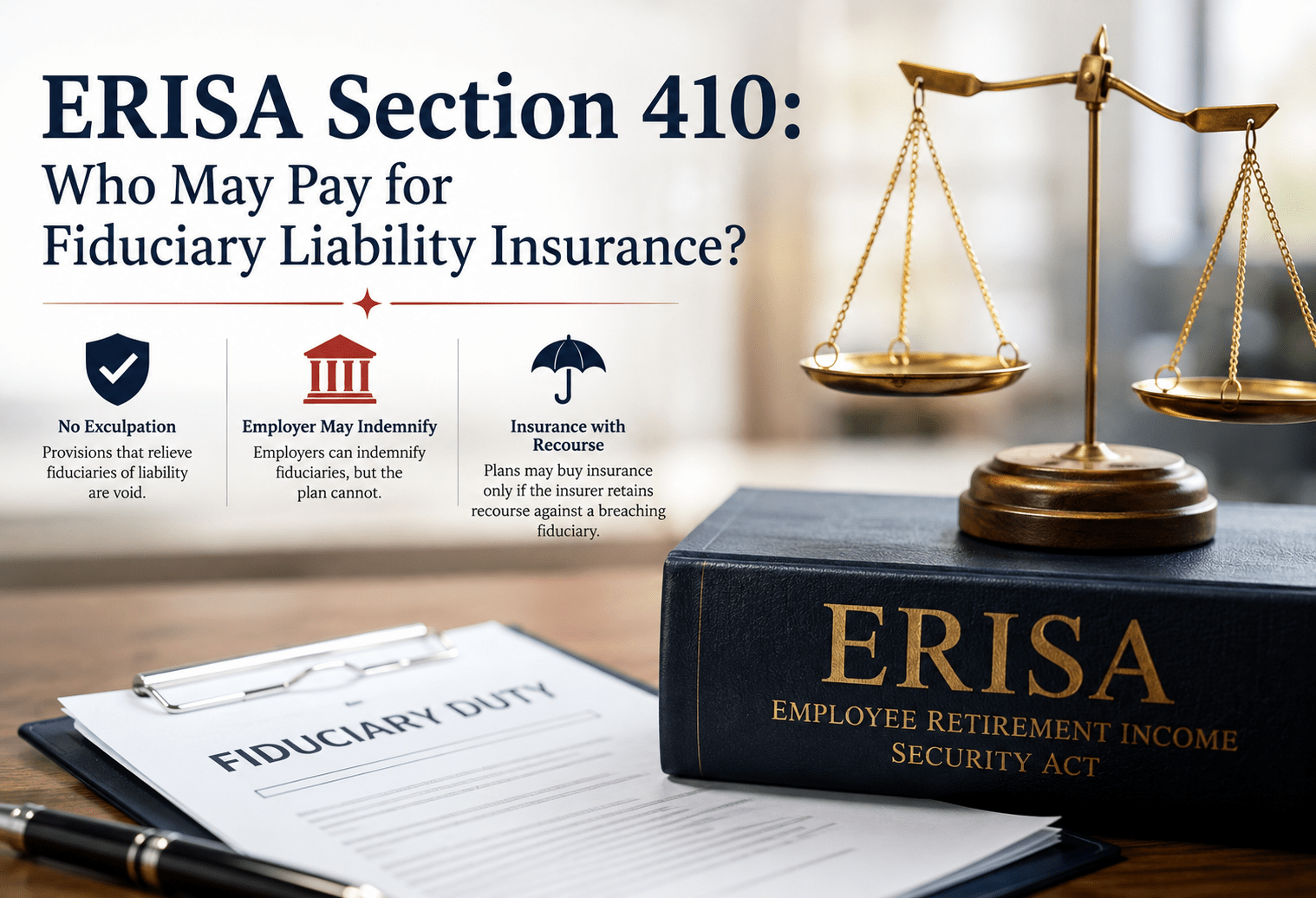
Fiduciary liability insurance exists precisely because ERISA section 409 imposes personal liability on fiduciaries to make good to the plan any losses resulting from a breach of their duties and to restore to the plan any profits made through the use of plan assets (29 U.S.C. § 1109). Section 410 prohibits the plan from indemnifying its fiduciaries against that liability, though it expressly permits the purchase of insurance for that purpose (29 U.S.C. § 1110). The fiduciary liability insurance policy is the instrument that fills the gap the statute deliberately leaves open.
The standard fiduciary liability form insures against “Loss” arising from a “Claim” alleging a “Wrongful Act,” and Wrongful Act is defined, with minor variation across carriers, as any actual or alleged breach of the responsibilities, obligations, or duties imposed on fiduciaries by ERISA or by common law, together with any negligent act, error, or omission in the administration of the plan. The insureds are the sponsor organization, the plan, and the natural persons who serve as trustees, administrators, committee members, and fiduciaries. A putative class action by participants alleging breach of the duty of loyalty and prohibited transactions is not merely within the coverage grant; it is the paradigm case the coverage was designed to address.
Three features of the form are worth confirming against the USI facts. First, defense costs are covered and are typically within limits, so the sponsor’s budget for the matter is the aggregate limit less what its lawyers consume before any resolution. Second, the insured versus insured exclusion, which in a directors and officers policy would bar claims brought by one insured against another, is in the fiduciary liability form almost universally carved back for claims brought by participants and beneficiaries, and the exception applies notwithstanding that the USI plaintiffs are also USI employees. The plaintiffs sue in their capacity as participants, not as insured persons, and the exclusion should not be triggered. Third, the policy is a claims-made form, and the sponsor’s obligation to give notice within the policy period or any extended reporting window is strict. The prior 2021 retirement plan action raises a related concern: if the current claim is deemed to arise from facts or circumstances noticed under an earlier policy, the carrier on risk in 2021 rather than the carrier on risk in 2026 may be the responding insurer, and the two will have different limits, different retentions, and possibly different definitions of Loss.
Sponsors who have never seen their own fiduciary liability insurance policy, or who have assumed that the fiduciary endorsement attached to a package policy is adequate, will find a treatment of the coverage architecture, the difference between a standalone form and an endorsement, and the underwriting information a carrier requires at FiduciaryLiabilityCoverage.com, the Surety One platform devoted to that product. The observation that follows from the USI facts is that the existence of fiduciary liability insurance is not the question; the question is what the policy defines as Loss.
The Disgorgement Problem
The relief sought in the USI complaint is instructive. The plaintiffs want the commissions and fees returned to the plan, USI removed as fiduciary, an independent fiduciary appointed, and prejudgment interest, costs, and attorneys’ fees (Romero 2026). Of those items, the one with the largest dollar value is the return of $3.46 million in commissions, and it is exactly the item that fiduciary liability insurance is least likely to pay.
Virtually every fiduciary liability form excludes from the definition of Loss any amount that constitutes the return of compensation or other consideration to which the insured was not legally entitled, and many exclude “disgorgement” and “restitution” by name. The exclusion is not an accident of drafting. It reflects the underwriting principle that insurance indemnifies loss and does not fund the return of gain, and it reflects a line of authority holding that a payment representing the return of ill-gotten profit is uninsurable as a matter of public policy because the insured has not, in any meaningful sense, been harmed by giving back what it should not have taken (Level 3 Communications, Inc. v. Federal Insurance Co., 272 F.3d 908 (7th Cir. 2001)).
That principle is not unbounded, and the applicable law in the Southern District of New York is more favorable to insureds than the Seventh Circuit’s formulation. In J.P. Morgan Securities Inc. v. Vigilant Insurance Co., 37 N.Y.3d 552 (2021), the New York Court of Appeals held that a payment labeled “disgorgement” in a regulatory settlement was nevertheless a covered Loss where the amount represented a penalty measured by third-party gains rather than the insured’s own profits. The decision turns on what the payment actually represents, not on the label the plaintiff or regulator attaches to it. Applied to the USI allegations, the question will be whether the commissions the plaintiffs seek to recover were, in fact, USI’s own gain. On the face of the complaint, they were, which places the disgorgement claim squarely within the exclusion and outside the coverage. A carrier will defend the section 406(b) count, and will probably fund a settlement allocable to the section 404(a) prudence theory and to the plaintiffs’ fee award, but it will contest any allocation of settlement dollars to the return of commissions.
The sophistication of the sponsor’s coverage counsel will therefore matter more here than in an ordinary excessive fee case. Section 406(b) actions are frequently pleaded alongside section 404(a) actions on identical facts, and the allocation of a global settlement between a covered breach of prudence theory and an uncovered restitution theory is negotiated, not dictated. A sponsor with a fiduciary liability insurance policy containing an “alleged” rather than “actual” formulation of the personal profit exclusion, or a policy lacking a final adjudication trigger, is in a materially worse position than one whose broker negotiated those terms at placement.
The Conduct Exclusions
The complaint characterizes USI’s conduct as “knowing, willful, or at least reckless” (Romero 2026). That language is drafted to satisfy the scienter element necessary for the plaintiffs’ equitable relief, but it also implicates two exclusions common to fiduciary liability insurance forms: the exclusion for willful violation of ERISA or any other statute, and the exclusion for personal profit or advantage to which the insured was not legally entitled.
In contemporary fiduciary liability forms both exclusions require a final, non-appealable adjudication in the underlying action establishing the excluded conduct before they apply, and both are severable, so that the knowledge of one insured is not imputed to another. The practical consequence is that the conduct exclusions do not affect the duty to advance defense costs and rarely affect the funding of a negotiated settlement, since a settlement is not an adjudication. They do affect the carrier’s leverage in settlement discussions, and a sponsor should expect a reservation of rights letter that cites both exclusions in its first paragraph. A sponsor whose policy contains an older “in fact” formulation, under which the carrier may deny coverage on its own determination that the excluded conduct occurred, should have that language corrected at the next renewal regardless of how the USI matter resolves.
The Non-Monetary Relief
The plaintiffs also seek removal of USI as fiduciary and appointment of an independent fiduciary to administer the plan. Injunctive and equitable relief of that kind is not Loss under any fiduciary liability insurance form, and no carrier will pay to install a replacement trustee. The costs of defending the request for such relief are ordinarily covered, because defense costs attach to the Claim as a whole rather than to its constituent counts. The distinction is worth articulating in the tender letter so that the carrier’s acknowledgment of coverage for defense costs is not later narrowed by reference to the equitable counts.
The Errors and Omissions Tender
USI’s dual role introduces a coverage question that the earlier voluntary benefits defendants did not face. The alleged wrongful conduct consists of USI’s actions as a broker: selecting carriers, negotiating commission schedules, and receiving compensation from insurers under producer agreements. That is professional services conduct, and USI, like every brokerage of its size, carries an insurance agents and brokers errors and omissions policy that covers claims arising from the rendering of, or failure to render, professional services.
The E&O carrier will receive a tender, and it will resist it. Most agents E&O forms contain an exclusion for claims arising from the insured’s own employee benefit plans, on the theory that the brokerage’s exposure as a plan sponsor is a fiduciary exposure appropriately insured under a fiduciary liability form rather than a professional exposure. The fiduciary liability carrier, for its part, may point to an “other insurance” clause or to an exclusion for professional services rendered to third parties and argue that the E&O policy is primary. The resulting dispute between the two carriers is the kind of allocation fight that consumes months of a sponsor’s attention and produces a coverage action that runs parallel to the underlying case.
The lesson generalizes beyond USI. Any organization that both sponsors a plan and provides services to it, whether as broker, recordkeeper, investment adviser, or third-party administrator, has an exposure that straddles two policies drafted by two carriers who did not consult one another. The time to resolve the straddle is at placement, by securing an express carve-back in the E&O form for claims arising from the insured’s own plan or by negotiating a fiduciary liability form that does not exclude professional services rendered to the plan by the sponsor.
What the USI Complaint Means for Every ERISA-regulate Plan Sponsor
The USI plaintiffs’ theory does not depend on any feature unique to a brokerage. Every employer that offers voluntary accident, critical illness, hospital indemnity, or supplemental life products through payroll deduction, and that has a broker of record collecting commissions on those products, faces a version of the same allegation: that the sponsor failed to monitor the broker’s compensation and thereby permitted excessive premiums. The Frier Levitt analysis of the LabCorp complaint notes that the plaintiffs there benchmark the loss ratio of the voluntary products against the medical loss ratios required in government programs and argue that a product whose broker commission approaches thirty percent of premium cannot possibly return sixty percent of premium in benefits (Frier Levitt 2026). The same arithmetic will be applied to any sponsor’s Schedule A.
Four practical conclusions follow. First, the section 412 bond is not fiduciary protection, and a sponsor who believes otherwise is uninsured against the exposure that matters. Second, fiduciary liability insurance is the responding coverage, and it should be a standalone form with limits sized to the defense cost of a class action rather than an endorsement purchased as an afterthought. Third, the definition of Loss, the disgorgement carve-out, the formulation of the conduct exclusions, and the prior notice provisions are the terms that will determine whether the policy pays, and those terms are negotiable at placement and not afterward. Fourth, a sponsor that also provides services to its own plan must reconcile its fiduciary liability and E&O forms before a claim forces the two carriers to reconcile them in litigation.
The voluntary benefits wave is not likely to recede. The plaintiffs’ bar has found a category of ERISA plan in which commission disclosure is public, loss ratios are calculable from filed data, and the fiduciary process on the sponsor side has, in many organizations, been nonexistent. The USI complaint, by naming a defendant that sat on both sides of the table, has made the coverage question unusually visible. Sponsors who read their fiduciary liability insurance policy this quarter will be in a better position than those who read it when the summons arrives.
So, I am not counsel to any party in the matters discussed. Nothing in my piece here constitutes legal advice or a coverage opinion on any specific policy. Follow the ERISAblog to keep abreast of this sort of update.
~ C. Constantin Poindexter, MA, JD, CPCU, AFSB, ASLI, ARe, AINS, AIS, CPLP
References
- DLA Piper. 2026. “US Federal: Voluntary Benefit Programs Face Increased ERISA Fiduciary Scrutiny: Top Points.” Global Employment Latest Developments, March 23, 2026.
- Frier Levitt. 2026. “Self-Funded Employee Health Benefit Plans and Consultants/Brokers Face String of ERISA Fiduciary Breach Lawsuits for Mismanagement of Voluntary Benefit Programs.” February 5, 2026.
- Holland & Knight. 2026. “Understanding the New Wave of ERISA Litigation Targeting Voluntary Benefit Plans.” Insights, January 16, 2026.
- J.P. Morgan Securities Inc. v. Vigilant Insurance Co., 37 N.Y.3d 552 (2021).
- Level 3 Communications, Inc. v. Federal Insurance Co., 272 F.3d 908 (7th Cir. 2001).
- PLANSPONSOR. 2021. “USI Insurance Latest to Face ERISA Self-Dealing Complaint.” March 11, 2021.
- Plan Sponsor Council of America. 2025. “New Wave of ERISA Litigation Targets Voluntary Benefits.” December 29, 2025.
- Romero, Tez. 2026. “USI Insurance Employees Sue Over Voluntary Benefit Commission ‘Self-Dealing.'” Insurance Business America, September 9, 2026.
- Ropes & Gray LLP. 2026. “Voluntary Benefits Under Scrutiny: Multiple Plan Sponsors and Consultants Sued for Alleged ERISA Breaches.” Insights, February 2, 2026.
- Verrill Dana LLP. 2026. “Voluntary Benefits Move into the ERISA Litigation Crosshairs.” July 22, 2026.
- Employee Retirement Income Security Act of 1974, §§ 404(a), 406(b), 409, 410, 412, 29 U.S.C. §§ 1104(a), 1106(b), 1109, 1110, 1112.
- 29 C.F.R. § 2510.3-1(j) (Department of Labor safe harbor for certain group insurance programs).
- 29 C.F.R. Part 2580 (Department of Labor regulations on temporary bonding rules under ERISA section 412).